Your first win is ready.
This one isn’t part of the regular lessons. It’s a members-only video, and it’s built to change how you sound today — not in six months.
Start here
Pick your level.
One video. Not three. Pick where you are right now and you’ll get the one that fits.
Pick one and watch it today. You can come back and change it any time.
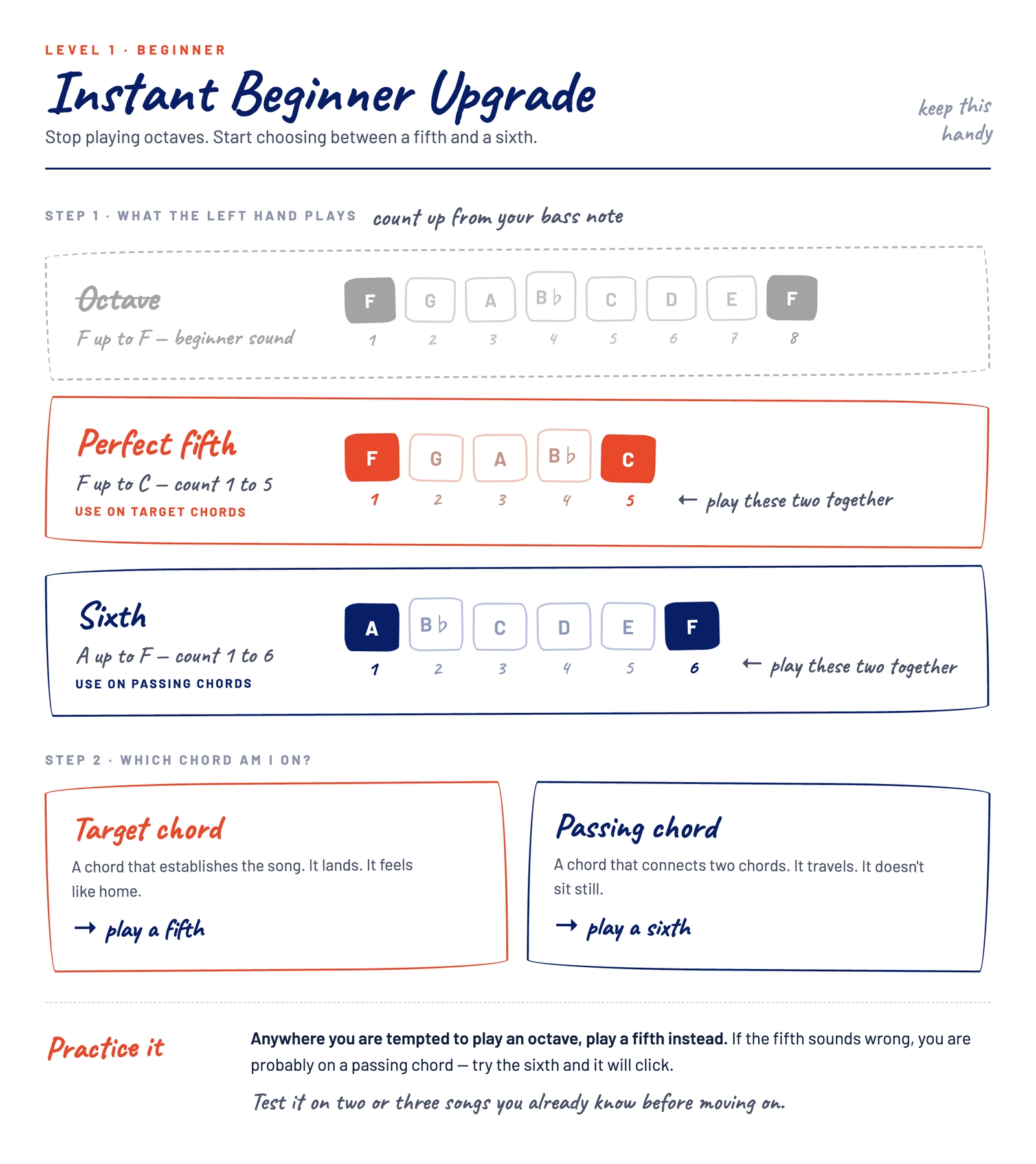
Stop playing octaves in your left hand.
Octaves are the sound that tells everyone you’re new. Change two notes and the whole song sounds more finished.
1 Play fifths on your target chords
A target chord is a chord the song lands on and rests. In the key of F, instead of playing F and F an octave apart, count up five and play F and C.
Same hand shape, one note moved. That’s the whole change.
2 Play sixths on your passing chords
A passing chord connects two chords. It doesn’t rest — it moves. On those, count up six instead. If your bass note is A in the key of F, play A and F.
Rest = fifth. Move = sixth. That’s the rule.
3 Test it on a song you already play
Pick a hymn or song you know well. Sean uses Amazing Grace in the video. Every place you reach for an octave, play a fifth instead.
If the fifth sounds wrong, that chord is probably a passing chord. Try the sixth there.
How long this should take
- Today: one song, fifths only.
- This week: two or three songs, fifths and sixths.
- Don’t: try to fix every song at once. One song done right teaches your ear more than five done halfway.
Keep this handy
The one-page sheet
Everything in the video on one page. Print it and set it on the piano.
 Download the sheet
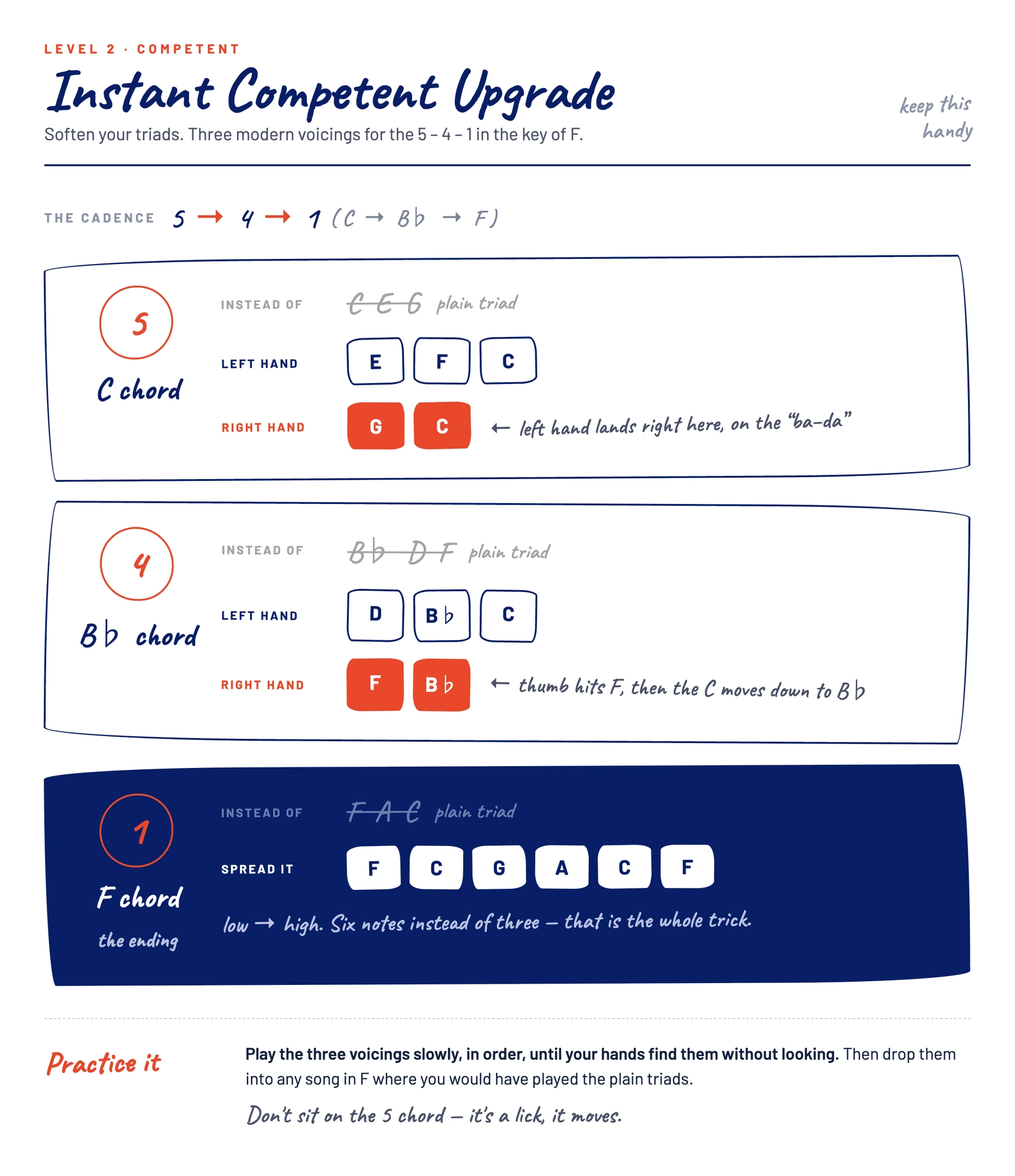
Soften your triads with better voicings.
Straight triads are what make a decent player still sound plain. This one lick modernizes your five chord instantly.
1 Learn the right hand first
Key of F. In your right hand, play C – D – F – G – G – A.
Slow first. Get it clean before you add anything under it.
2 Add the left hand on the last two notes
When your right hand hits the G–A, your left hand plays E – F – C.
That’s your C chord. It doesn’t look like one, and that’s the point — it’s a softer way to say the same thing.
3 Move to the four chord and land
Take your right thumb to F. As you do, your left hand changes from E–F–C to D – B♭ – C.
Then resolve down to your F chord. Five to four to one — but nothing sounds blocky.
Where to use it — and where not to
- Use it: any time you’d play a plain C chord in the key of F — endings, intros, turnarounds.
- Timing matters: it’s a lick, not a resting place. Don’t sit on it.
- Today: get it under your hands at one tempo. Speed comes later.
Keep this handy
The one-page sheet
All three voicings written out, note for note. Print it and set it on the piano.
 Download the sheet
A passing chord system you can move anywhere.
Intermediate players don’t just know more chords. They know where a chord is going — and how to walk into it.
1 Walk the minor chord up in half steps
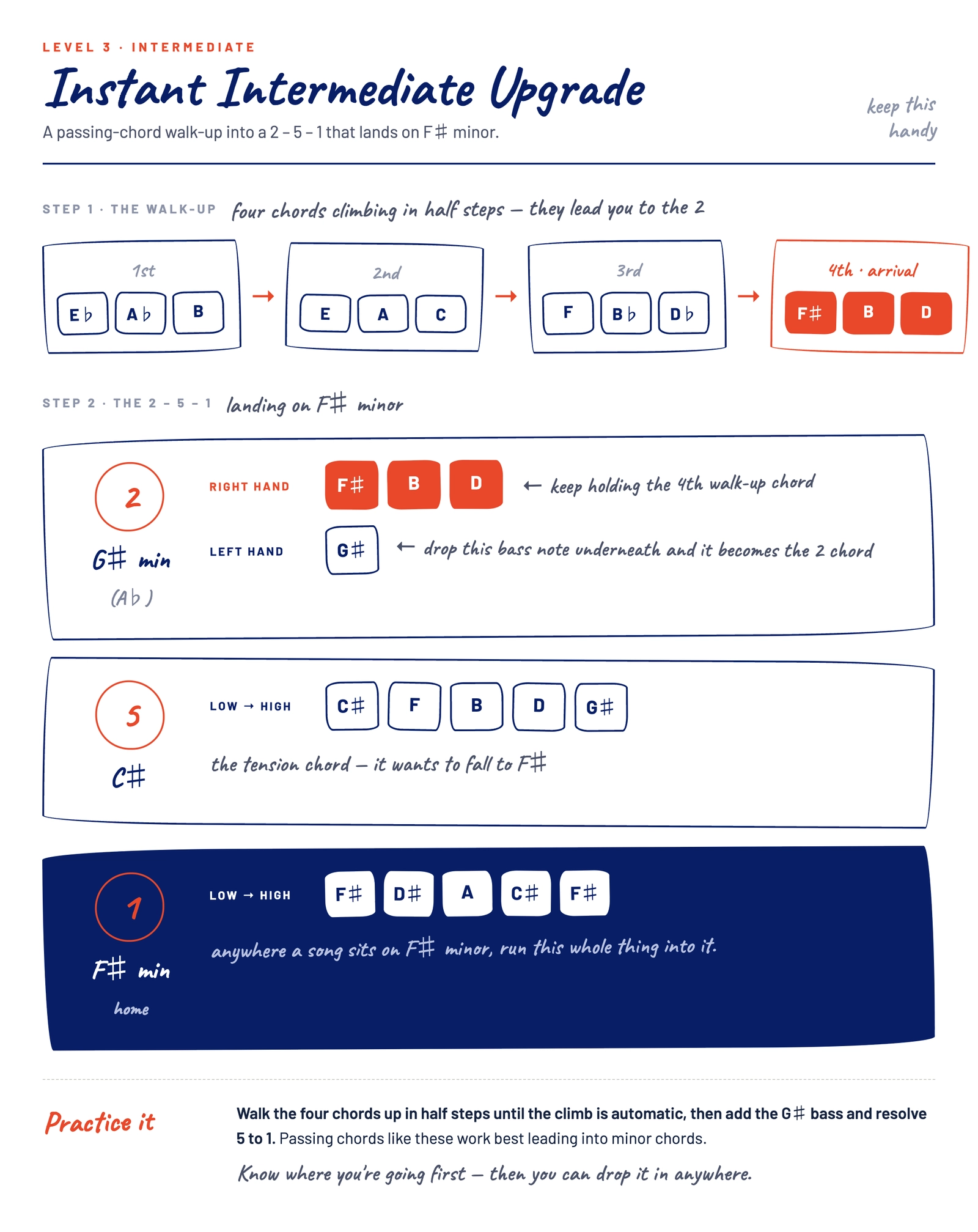
Four chords, climbing in half steps. Keep the shape and move the whole hand: E♭ A♭ B → E A C → F B♭ D♭ → F♯ B D.
Sean’s point in the video: a lot of these look like minor chords but function as half diminished. That difference is the next lesson — for now, just hear the climb.
2 See where the walk-up is going
That climb is walking you into a two–five–one. Hold the last walk-up chord, drop G♯ in the bass, and it becomes your two. The five is C♯. It resolves to F♯ minor.
Once you see that, the whole run stops being a lick you memorized and becomes a road you can take from anywhere.
3 Drop it in wherever that target appears
Anywhere a song sits on F♯ minor, run this whole thing into it. Sean demonstrates it inside Amazing Grace.
Passing chords like these work best leading into minor chords. Look for those first.
The honest limit of this video
You can use this today in one key. Moving it through all twelve takes a practice system — diminished walk-ups, half diminished walk-ups, and knowing which is which.
That’s coming. Use this one in the key it’s in first.
Keep this handy
The one-page sheet
The walk-up and the two–five–one, chord by chord. Print it and set it on the piano.
 Download the sheet
Coming next
Knowing it isn’t the same as owning it.
At the end of your video, Sean promised you the practice system — how to drill this so it holds up under pressure and moves to other keys. Get this one under your hands first.
Watch it once. Then go sit at the piano and use it. That’s the whole assignment.
Sean

