You've seen what's possible.
You've watched the videos. You've seen them live. You've seen the energy. You've sat in church and heard someone play something that stopped you cold. And you know exactly how it feels.
And you still don't know how to get there.
That gap — between what you hear and what you can play — isn't a talent problem. It's a vocabulary problem. And it's fixable.
I've been exactly where you are.
My name is Sean Wilson. I've been playing piano for over 30 years. I'm a Music Director. I teach college-level mathematics. I've played in churches my whole life.
But for almost a decade, I stopped playing completely.
Not because I didn't love music. Because I felt stuck — and I couldn't figure out why.
I could play songs. I always had a decent ear. But I didn't understand what I was playing. I was copying, not creating. And somewhere along the way, that feeling — of watching other amazing musicians and thinking something must be wrong with me — got heavy enough that I just stopped.
The thing that brought me back wasn't motivation. It was a question a friend asked me:
Do you understand the music or are you just playing it?
That question changed everything
What I figured out changed how I teach.
When I came back, I didn't just start playing again. I started studying — really studying — how great musicians think. What they hear. How they build vocabulary. How they develop the kind of freedom that looks effortless from the outside.
And I went back to basics in a way I never had before.
I started playing for my mom's Church Sunday Sabbath school class. This was a room full of two-year-olds singing simple songs, no charts, no key announced, just figure it out. And because nobody was watching, nobody was judging, I stopped performing and started experimenting. I made mistakes. I tried things. I treated every song as a lab, not a performance.
That shift in mindset, from performing to experimenting, is what actually unlocked my growth. It's something I still do today. I'll break out drop 2 voicings during church announcements just to see what happens.
Then came the harder problem.
I started transcribing!! Trying to figure out what musicians were actually playing. I was obsessed. I'd isolate one chord at a time, slow things down, and spend an entire week getting 30 seconds into a song. It was the hardest thing I'd done musically. I was sweating through this process and sharing my insights on Youtube.
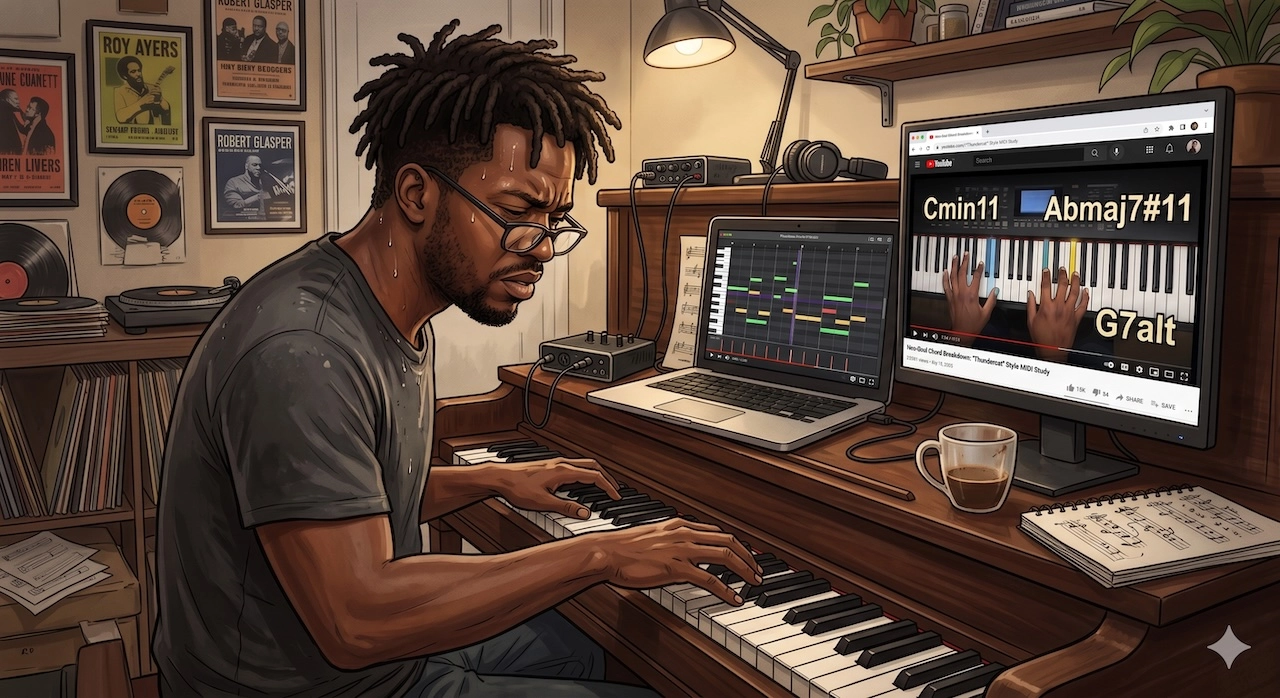
But something happened as I kept going. I stopped needing to ask people what they were playing. I stopped needing slow-down software. The time it took me to figure out what a musician was doing kept shrinking.
My ear was developing, but only because I had a process, not just effort.
Then came the third problem: I could hear the chords, but I couldn't execute them in real time. Getting what I heard in my head to show up in my hands at the moment the musician played it. That's where most people get stuck and never get out.
What I discovered, through years of transcribing, studying, and teaching, is that every great musician moves through three stages. They build their fundamentals until those fundamentals are automatic. They absorb the language of real musicians by studying what those musicians actually play. And only then, do they start creating freely.
Most musicians never get past stage one. Not because they lack ability. They didnt have a proper path of learning
That became the Master Musician Growth Framework. And it's the foundation of everything inside this membership
Here's what students are experiencing.
Members inside the program aren't just learning songs. They're developing musical vocabulary they can actually use. They're understanding why chords move the way they do. They're showing up to rehearsal with confidence they didn't have six months ago.
One member told me he finally understood what he was hearing in gospel music and not just how to copy it,
but understand why it works. That's the shift. From copying to understanding. From stuck to moving.
This is not a tutorial library.
You're not here to collect videos. You're here to develop the skills that make you a musician, someone who hears something and knows what to do with it.
The membership gives you a structured roadmap, monthly training, a community of serious musicians, and direct access to a framework that actually moves you forward.
Try it for $1.
The question that brought me back wasn't "how do I get better."
It was do you actually understand what you're playing?
That's a different question. And it changes everything about how you practice, what you listen for, and how fast you grow.
That's what this membership does. It doesn't just give you things to play. It helps you start asking the questions that real musicians ask.
One dollar. Full access. Start asking better questions

